AI agents for wholesale distributors can reduce the work involved in preparing orders and quotes. Artificial intelligence (AI) interprets customer requests and chooses actions within limits you set. Financial value depends on the work removed, the review that remains and the full operating cost. This guide explains those trade-offs using an illustrative order-processing model, rather than promised savings.
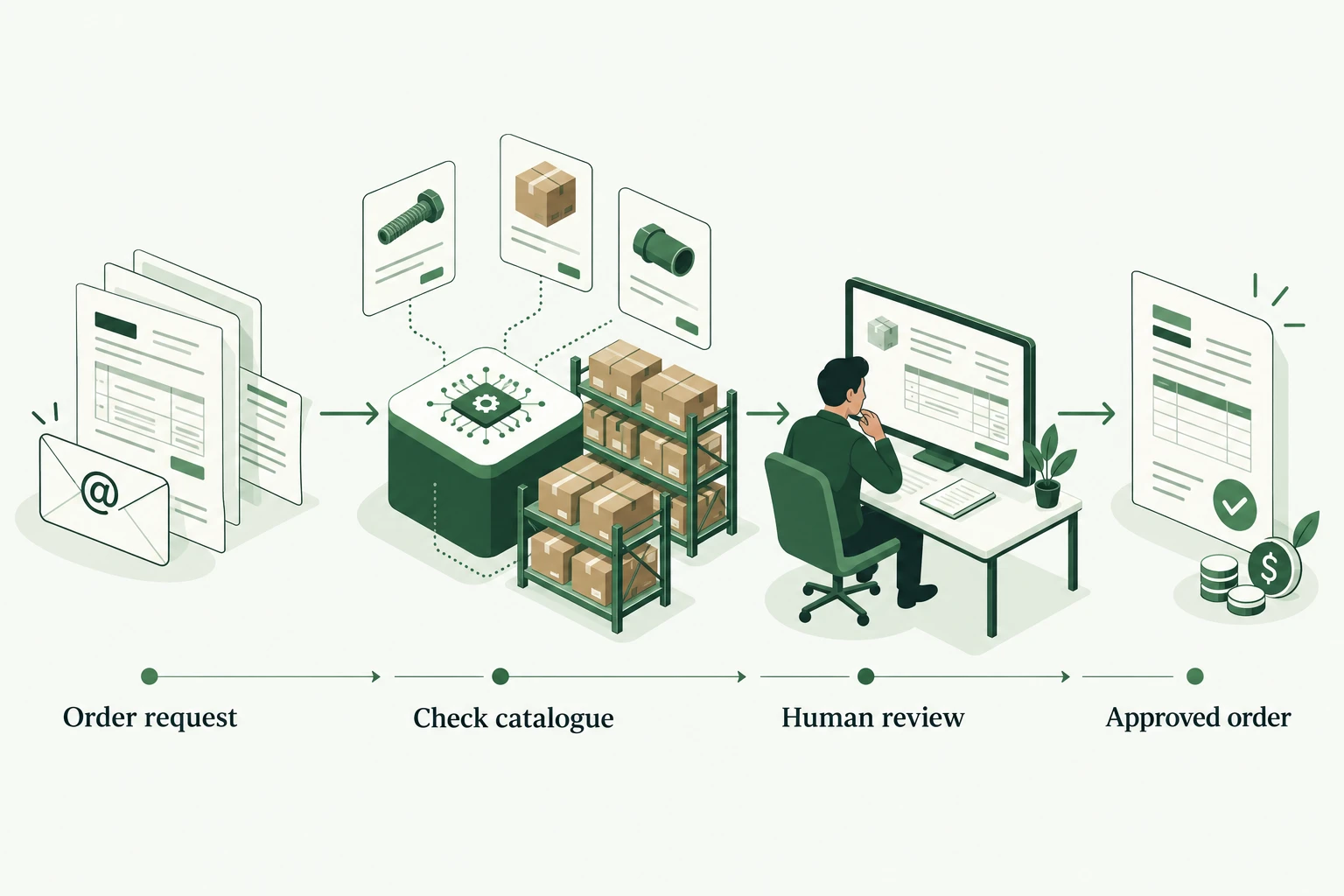
Where an AI agent fits in a wholesale business
An agent can interpret an emailed order and choose which approved tool to use next. It might search your product catalogue, request missing details or prepare a draft quote. Your enterprise resource planning (ERP) system remains the record for stock and commercial terms.
A fixed automation follows a predefined sequence, while an agent can select its next action from the information it finds. That flexibility helps with requests that arrive in different formats. A repeat order containing valid product codes may need only fixed rules.
Anthropic describes this distinction between workflows and agents in its engineering guidance. Use it to decide whether interpreting the request adds value. Adding an agent to a predictable process also adds usage costs and review responsibilities.
Connect each use case to a financial outcome
Start with a repeated task whose cost you can measure. Order preparation offers a defined starting point because you can count requests and record handling time. Other use cases need their own baseline and owner.
The table separates possible operating benefits from evidence you need before putting them into a budget:
| What to compare | Possible benefit | What to measure |
|---|---|---|
| Order preparation | Less rekeying from emails into draft orders | Net minutes removed after review and corrections |
| Quote preparation | More sales capacity for responding to requests | Preparation time and contribution from additional fulfilled orders |
| Order-status replies | Less time searching for confirmed shipment information | Handling time and accuracy of customer replies |
| Replenishment review | Earlier visibility of items needing a buyer’s attention | Stock availability and inventory cost against a comparable baseline |
These are potential uses, not claims that one agent delivers every outcome. Stock purchasing and customer credit decisions need their own approval rules.
Follow an order from the inbox to a reviewed draft
Consider a customer emailing a purchase order with a mixture of product codes and descriptions. The agent can prepare structured lines for review. A product code identifies a catalogue item; the unit of measure specifies whether the quantity means individual items, cases or another unit.
Microsoft’s Business Central Sales Order Agent documents a related pattern: interpret an email, check items and prepare a quote. Its documentation also requires designated people to approve outgoing customer messages. This shows a documented product pattern, rather than a savings benchmark for your business.
For a pilot, keep the final commercial decision with your team. Use this bounded sequence:
Identify the request
Match the sender to an authorised customer and check whether the purchase order already exists.
Extract the order lines
Read requested products, quantities and delivery details, retaining the original document for comparison.
Check catalogue records
Match product identifiers and units, then retrieve approved customer pricing and current availability.
Prepare a draft
Create a draft quote and flag ambiguous products, missing information or conflicting terms.
Review and approve
Ask the responsible person to check the draft before any customer commitment or order release.
Protect margin with authoritative commercial rules
Require the agent to retrieve prices from approved records instead of generating them. A plausible quote can still use the wrong customer discount or pack size. Keep the source of each commercial field visible to the reviewer.
A request for ten cases must not become an order for ten individual units. Route uncertain matches to someone who knows the catalogue. Apply the same review requirement to substitutions that affect compatibility or specification.
Treat available stock and a promised delivery date as separate facts. Your ordering rules must account for allocations and confirmed supply before making commitments. If the inventory connection fails, pause the draft rather than inventing an answer.
Microsoft’s setup guidance allows an agent to pause after preparing a quote for manual pricing or discount work. Your own workflow should define comparable boundaries. Give it only the access needed for the agreed task.
Calculate capacity value after human review
Count the handling time that remains before estimating a benefit. The following figures describe a hypothetical distributor, not a client result or a ParmarWorks quotation. All amounts are in pounds sterling and exclude value added tax (VAT).
Assume 1,200 eligible requests per month, each currently taking eight minutes to prepare. Suppose the pilot reduces total human handling to three minutes per request, including approval and exception work. That removes five minutes per request, or 100 hours per month.
At an assumed fully loaded labour cost of £25 per hour, those hours represent £2,500 of capacity. Fully loaded cost includes employment costs beyond salary. The value becomes a cash saving only when actual spending falls, such as overtime or temporary staffing.
If your payroll stays unchanged, record the benefit as available capacity. Give that time a defined use, such as handling additional orders or resolving customer issues. Do not describe it as £2,500 entering the bank account.
| What to compare | Illustrative monthly calculation |
|---|---|
| Current handling | 1,200 × 8 minutes ÷ 60 = 160 hours |
| Remaining handling | 1,200 × 3 minutes ÷ 60 = 60 hours |
| Recovered capacity | 160 − 60 = 100 hours |
| Capacity value | 100 hours × £25 = £2,500 |
Include the full cost before judging the result
Compare capacity value with both ongoing costs and implementation work. For this example, assume £1,200 per month for operation and support. Add £200 for software and AI usage, plus £100 for internal ownership outside per-request handling.
Assume a separate £3,000 implementation cost and spread it over twelve months for comparison. That adds a £250 monthly allowance, bringing the comparison cost to £1,750. This allowance does not change when the implementation invoice needs paying.
The base case produces £750 of net monthly capacity value: £2,500 less £1,750. It does not establish a cash return on investment (ROI). Ask for an actual quote covering integration work and charging units before making a purchase decision.
Use the same assumptions to test whether the decision depends on order volume:
| What to compare | Lower volume | Base case | Higher volume |
|---|---|---|---|
| Eligible requests per month | 600 | 1,200 | 1,800 |
| Net minutes removed per request | 5 | 5 | 5 |
| Capacity hours recovered | 50 | 100 | 150 |
| Capacity valued at £25 per hour | £1,250 | £2,500 | £3,750 |
| Monthly comparison cost | £1,750 | £1,750 | £1,750 |
| Net capacity value | −£500 | £750 | £2,000 |
The sensitivity table holds costs and handling time constant to isolate volume. Actual usage charges, support effort and exception rates can change with volume. Validate them at each workload.
Measure extra sales using contribution, not revenue
Value any additional sales using the contribution left after their variable costs. An extra £10,000 of revenue does not create £10,000 of profit. Deduct product costs and incremental fulfilment costs before attributing value to the agent.
For illustration, assume additional fulfilled orders generate £4,000 of revenue with £3,200 of variable costs. The contribution is £800. You still need evidence that the agent caused those additional orders, rather than a change in demand or pricing.
Avoid counting the same time twice. If recovered staff hours produce those extra orders, claiming their full capacity value and the resulting contribution overstates the benefit. Report a capacity view or a realised cash-and-contribution view, with the assumptions for each.
Treat fewer order errors in the same way. Measure avoided credits, returns or rework against comparable orders before claiming savings. If correction time already appears in net handling time, do not add it again.
Use a bounded pilot to test the financial case
Run the pilot on one customer group and a defined set of products. Record the manual baseline before changing the process. Compare similar order sizes and product mixes so that easier orders do not distort the result.
Start with draft preparation and human approval. Count failed requests as part of the workload, including time spent recovering them. A system that processes selected orders well can still create an expensive exception queue.
Agree your acceptance criteria before reviewing the outcome. Measure these items during the pilot:
Expand only when measured value exceeds the full cost and the commercial checks meet your agreed standard. Narrow or stop the pilot if it creates more review work than it removes.
- Eligible request volume and the share that reaches a usable draft
- Total handling minutes, including review, corrections and exceptions
- Incorrect products, quantities, units and customer prices
- Software charges and internal maintenance time
- Actual overtime avoided or additional contribution generated
Questions about wholesale AI agents and financial value
Your ordering systems and data quality determine what you can delegate. These answers cover the practical limits behind the financial model.
Can an AI agent work with an existing ERP?
It depends on the ERP’s supported connections and permissions. Check whether your system allows catalogue lookups and draft creation without releasing live orders. Budget for any integration or data preparation work separately.
Does an agent need to replace order-entry staff?
No. It can prepare drafts while your team handles approvals and exceptions. Whether that creates a financial benefit depends on how you use the released capacity or reduce actual costs.
Will it choose substitute products automatically?
Only if you deliberately allow that behaviour. For the pilot described here, a person approves substitutions and ambiguous matches. A similar description does not establish that two products meet the same specification.
What if the distributor has low order volume?
The fixed cost can exceed the time value recovered, as the lower-volume scenario shows. A smaller fixed workflow or an improvement to existing ERP features may cost less. Compare those options before commissioning an agent.
THE TAKEAWAY
Start with one measurable order or quote process. Subtract review time and full operating costs, then separate available capacity from cash savings. Use your pilot evidence to decide whether an agent earns a wider role.

Nik Parmar
Founder of ParmarWorks. Building practical automation and connected systems for service businesses.